



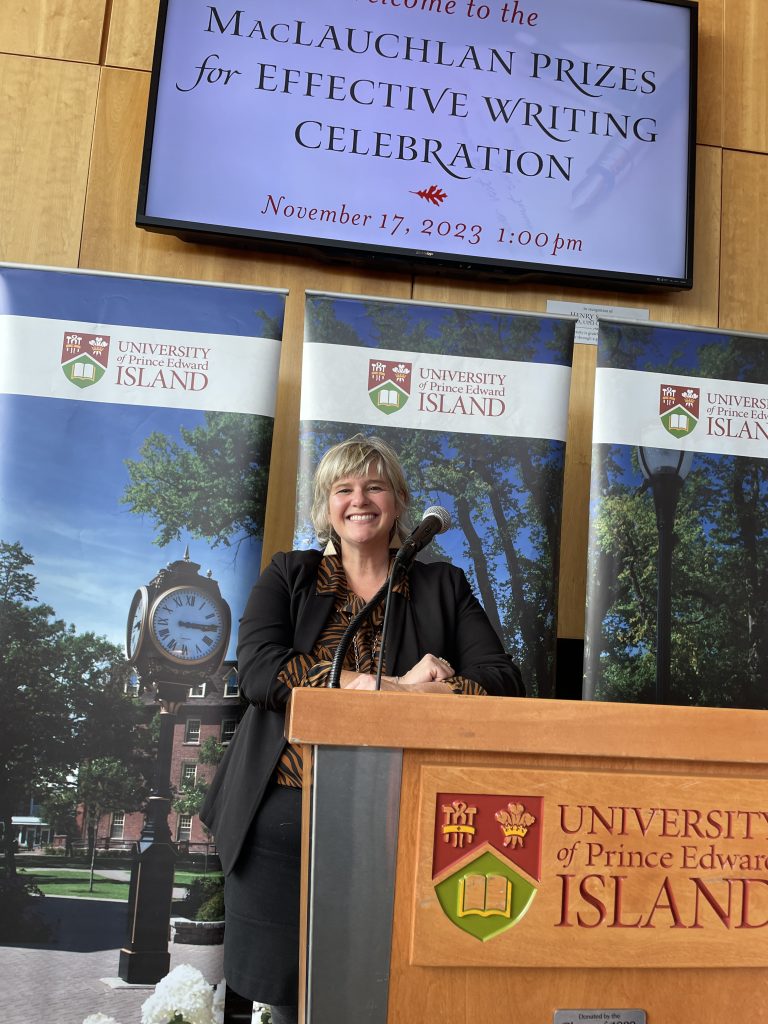
I was so excited to be asked to speak recently at a University of Prince Edward Island event, the MacLauchlan Awards for Effective Writing. It celebrates the excellence across all faculties, not only in liberal arts, but all social sciences and business. They asked me to share a few words about my highlights as a a writer. But all of a sudden, my mind filled not with my accomplishments, but with vulnerability, rejection letters, my unfinished plays. The time I couldn’t get the review done. The time I didn’t make my deadline.
But then, I thought about story, and the value of the wait, and the words just started to come.
Listen to your stories. They are the ones who talk to you. They do your emotional labour. They rationalize, they feel your pain, your sorrow. They know you, like no one else does. But they also celebrate with you, they see your joy, the vulnerability of change, the elastic pull of time. They simmer, they get hot. Eventually, they create the words that pour out of you.
Over time, and draft, and revision and more, I developed my authorial voice. Writers are a bit stubborn at this, and like anything else, the development of this voice takes practice.
And it doesn’t have to be daily, or weekly, or even monthly. But it is in the consistency that the words become louder, that they begin to vibrate.
You wait for them, if you need to.
And I started to think about what my authors always needed to hear. Make time to connect with your words, the voice of the writer inside of you. Be steady. Write on the kitchen floor. Write at the airport. Write in the cafe. Write anywhere, on napkins, on receitps, write all the time.
Writer’s aren’t born, they’re made. We walk through fires, we fly through turbulence, and we scurry up from the sea. We are haunted, driven, and committed. And our stories must be told.
And then, once the flood gates opened, all of the advice i could ever think about exploded out of me. Take risks in your writing. Don’t see genre. Live your truths. Build structure. Be messy. Find sustaining work. Volunteer with writer’s organization. Build a network.
When you need to, lean on your community. Book coaches can create timelines for you, editors can read first chapters and writers can help you dream up where you should submit it. But sometimes when we succeed in one area of life, we fail in another. Writing schedules can go by the wayside if you have a new job, a new baby, or when you have to walk a dog every day. You fall out of sync with it. And before you know it, you forget.
Am I even a writer anymore? You will question yourself, question the validity of your choices, examine the meaning of life. The struggle becomes real. But for a writer though, this is fuel. The philosophical, that’s Kieerkegaard. The satirist, that’s Pope. The existential – that’s Simone de Beauvoir.
When you get tired of your own stories, go back to a critical examination of the stories of others. Connect the past to the present. The Present to the future. There has never been a more important time to be a witness when considering the state of events in the world.
Now, at Pownal Street Press, we talk to writers every day about the stories that writers feel can change the world. And our authors keep up going, their stories are here today, and they have a plan for the visions of tomorrow.
So wherever you are in the writing journey, you will always have all of your words with you, not behind you. Go forth!